
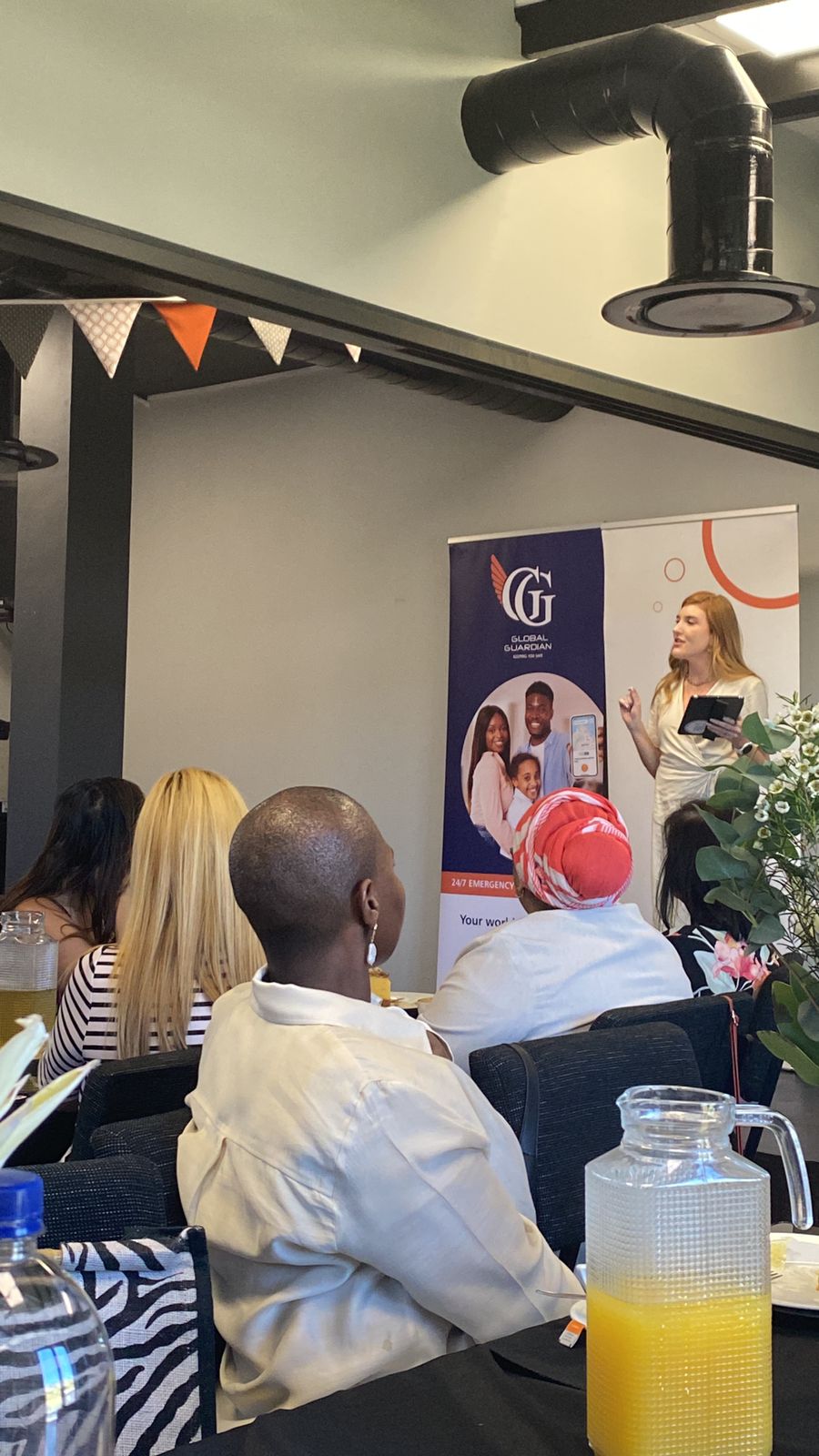
Last Wednesday, Are You OK and Global Choices hosted a breakfast for the Association of Women in Insurance (AWII) in the Western Cape, at Koffi Terapi in Willowbridge. The oversubscribed event was a resounding success — a clear sign of how much we all need regular check-ins with ourselves and with each other.
Billed as “Coffee and Connection,” the morning delivered that and much more. Between decadent cheesecakes, laughter, and lively conversation, Kayla led an emotive, relatable, and timely talk on burnout — reminding us that it’s okay to pause, breathe, and admit when we’re not okay.
Kayla finished the session guiduing us through a calming body scan, during which some of us drifted off into deep relaxation, while others simply took a rare moment to reconnect with themselves. The collective, contented sigh that followed said it all — a powerful reminder that even small moments of stillness can have a big impact on our physical and mental wellbeing.
As Kate aptly noted, this breakfast marks the beginning — the first of many gatherings to come. Because, we all need a seasonal, if not regular, Reset.
It’s Okay to Not Be Okay: A Conversation on Burnout, Balance, and Being Human
Key takeaways from Kayla’s talk…
As the year draws to a close, everything seems to speed up.
Deadlines tighten, clients grow anxious, and the to-do lists stretch endlessly — especially in industries like insurance, where the “holiday wind-down” often looks more like a sprint to the finish line.
And somewhere in the middle of it all, there’s us — trying to hold it together. Balancing work, family, and expectations, while hoping there’s still a little energy left for ourselves at the end of the day.
That’s why the AYO + AWII Women’s Talk: “It’s Okay to Not Be Okay” is here.
Not as another wellness lecture, but as a pause — a moment to breathe, reflect, and talk honestly about what it means to be human in a world that doesn’t always leave space for that.
Why Burnout — and Why Now
Burnout has become one of those words we toss around casually. “I’m so burnt out,” we joke over coffee. But burnout isn’t just fatigue — it’s depletion.
It’s when even the things you love begin to feel heavy. When you’re functioning, but not really feeling. When everything turns to grayscale.
This year, many of us have lived in constant “go mode” — managing teams, clients, households, relationships, and the emotional load of everyone around us. We tell ourselves to just “push through.” But here’s the truth: You can’t sprint a marathon.
Work shouldn’t break people. Yet, too often, it does.Not because we’re weak, but because we’re human — existing in systems that reward output more than restoration.
Recognising Burnout
Burnout doesn’t always look like falling apart.
Sometimes it looks like doing everything right — and feeling nothing.
It’s losing focus, snapping at small things, forgetting joy.
For women, burnout often hides behind over-functioning. Behind being the one who always says, “I’ve got it.” We take on more, believing that if we stop, everything will fall apart. But the truth is, the only way through burnout is not more effort — it’s rest.
The Body Keeps the Score – Mental health is health.
When your mind is overworked, your body will eventually tell the truth: headaches, insomnia, anxiety, a weakened immune system.
We’d never tell someone with a broken leg to “just keep running.” Yet we say that to ourselves emotionally every day.
Resilience isn’t about pushing through pain. It’s about recognising your limits and choosing recovery over collapse.
Four Small Shifts That Help
Awareness breaks denial. Saying “I’m not okay” is often the first act of healing.
You don’t need a month-long escape. Five minutes of stillness, sunlight, or music can remind your body: “You’re safe. You can rest.”
Rest is not a reward — it’s maintenance. You don’t earn it by doing more; you need it simply to function.
Burnout thrives in isolation. Asking for help is strength, not failure.
The Culture Around Burnout
Burnout doesn’t just live in individuals — it grows in cultures.
If the unspoken rule at work is “tough it out” or “don’t show weakness,” burnout is inevitable.
Work doesn’t happen in isolation from life. Life follows us to work, and work follows us home.
When leaders create cultures that value people as humans — not just producers — everything changes.
Empathy isn’t soft; it’s strategic.
It builds trust, loyalty, and performance. In psychologically safe workplaces, people don’t just survive — they thrive.
A Quiet Collapse
A few years ago, I hit my own wall. No big drama — just a quiet collapse.
I was still showing up, smiling, getting things done. But inside, I was empty.
It wasn’t until one morning, sitting in my car before work, that I realised I couldn’t keep pretending. Saying out loud, “I’m not okay,” became my turning point.
That small act of honesty softened my inner critic and opened the door to compassion — from myself and others. It didn’t fix everything, but it reminded me that I didn’t have to carry it all alone.
The Weight We Carry
Burnout isn’t just about deadlines — it’s about life.
Grief, loss, divorce, loneliness — all the invisible weights we carry quietly.
This time of year can amplify those emotions. Anniversaries, memories, and reflections surface, reminding us of what’s changed — or who’s missing.
Even if it’s subtle, it still counts. Those “little t” traumas — the daily stresses, the feeling of never being enough — add up.
In industries built on empathy, like insurance, that emotional load doubles. We hold our clients’ fears and stories on top of our own. No wonder we’re tired by October.
The Power of Empathy
In this industry, we talk about protecting clients. But how often do we talk about protecting each other?
Empathy is the bridge between wellbeing and performance.
It’s not about fixing — it’s about “holding space”. Listening without judgment. Sitting beside someone in their storm instead of trying to pull them out of it.
A “holding space” is one where you can exhale. Where you can say, “I’m not okay,” and know the world won’t fall apart. That kind of culture doesn’t just make people feel better — it makes them *stay*.
A Moment of Reflection
Think of someone in your life who might not be okay right now.
What would you say to them if you knew they were struggling?
Now — say it to yourself.
That’s compassion.
That’s the beginning of healing.
You don’t have to hold it all.
You don’t have to be okay all the time.
And you don’t have to do it alone.
Because the truth is —
It’s okay to not be okay
Contact Gustav gustav@areyouok.co.za to schedule a Workplace wellbeing session with Kayla and Kate.
_____________________________
About Us:
Are You OK (AYO) is an online mental health platform dedicated to creating real conversations around wellbeing — at work and beyond.
Through workplace facilitation, storytelling, and digital resources, AYO helps individuals and organisations build psychologically safe spaces where people feel seen, supported, and empowered to ask the simplest, most powerful question of all:
Are you okay?